An SME website should help visitors understand, verify and enquire
A prospect referred by a partner does not discover your business in the same way as a buyer arriving from Google. The first wants reassurance about your credibility; the second initially needs an answer to a problem. An SME website should support both journeys: explain what you do, show when you can help and enable a useful first conversation.
We plan the site around your services, available content and sales organisation. A service business may need to explain three areas of expertise and their supporting projects. A manufacturer may need to describe capabilities, materials and production constraints. A distributor may need to direct visitors to a catalogue or contact person without selling online.
Express the objective as an observable action: receiving a relevant enquiry, helping someone prepare for a meeting or allowing a partner to find documentation. Having a modern website describes a design intention; it is not enough to decide which pages and features to build.
Start with a usable project brief
A short but precise document makes decisions easier. Bring together management, someone close to your customers and the person who will update the content. Ask each of them about recurring questions before a quote, information that is hard to find and problems with the current website. Use the answers to organise the project, without automatically reproducing the company's organisational chart.
Prepare these six items before the first mockup:
- Priority services, relevant audiences and the areas you actually serve.
- The three essential journeys, from arrival to enquiry or download.
- An inventory of copy, photos, references, documents and usage rights.
- Tools to connect: email, CRM, catalogue, booking or document portal.
- The people responsible for writing, approval and administration.
- The available budget, recurring expenses and scheduling constraints.
France Num offers a complementary approach to documenting objectives, content, technical constraints and project stages. You can use its website project brief guide to support preparation, adapting each section to your business.

Which pages does your business need?
The page count follows the information you need to explain. A page for each genuinely distinct service helps visitors recognise their needs; several nearly identical pages mainly add maintenance. A starting structure could include a homepage, three service pages, a company profile, a reference directory, two case studies and a contact page. Prepare legal information and privacy pages alongside these according to your situation.
| Page | Visitor question | Content to prepare |
|---|---|---|
| Home | Am I in the right place? | Business activity, audiences, priority services and contact routes |
| Service | Can you meet my needs? | Scope, process, deliverables and limits |
| Case study | Have you handled a comparable situation? | Initial need, specific contribution and approved supporting material |
| Company | Who will I be working with? | Organisation, contacts and actual location |
| Contact | How should I describe my project? | Contact details, a short form and useful information |
For an industrial business, a capability page can complement the structure: materials, processes, accepted formats and a technical contact. For a consultancy, an engagement page explains the situations addressed and the deliverables. A recruitment website or customer portal introduces additional requirements to quote separately.
A very small team can start with a narrower scope. Our page on websites for very small businesses helps frame that situation; organising several subsidiaries or brands calls for a broader mid-sized business website approach.
Show evidence that supports a decision
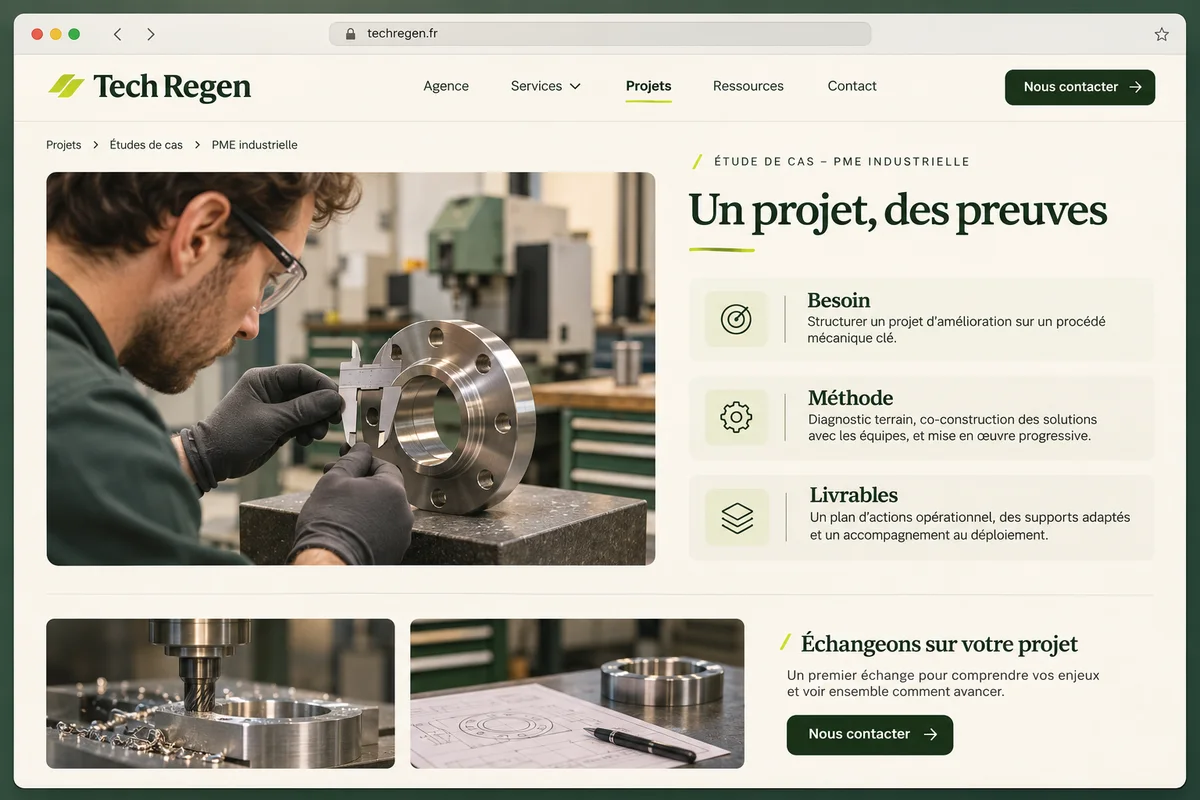
A case study should make your contribution clear. A client logo alone explains neither the assignment nor its context. Prepare a consistent structure: the problem, constraints, work performed, deliverables and a verifiable outcome where publication is possible. Obtain approval for names, photographs and confidential information before adding them.
If you cannot name the client, describe an anonymised case with their agreement and make the anonymisation clear. If you are starting out, show your method, demonstrations or clearly identified prototypes. Do not attribute a fictional project or an unmeasured result to a client.
A manufacturer can illustrate an inspection stage and identify the component involved; a service company can show a deliverable structure with private data removed. The text should explain what the image demonstrates. To see how we present documented projects, explore Tech Regen's portfolio.
Design a simple enquiry journey with reliable delivery
The form should gather enough information to route an enquiry while remaining usable on a phone. A name, a way to reply, a need category and a message may be sufficient for a first conversation. Make additional fields optional when they are not necessary at this stage; avoid requesting a complete dossier before knowing whether you can help.
Plan what happens after submission: confirmation, the main recipient, cover during absences and error handling. A button displaying 'sent' does not prove that the sales contact received the message. Acceptance checks include an authorised test submission, receipt in the correct inbox and checking what happens when a field is invalid.
A CRM connection requires its own scope: transmitted fields, deduplication, access ownership, failure notifications and third-party costs. We can plan this alongside website development, without assuming that every integration is included in a basic brochure website.
The data collected and third-party tools should be reviewed with the people responsible for your compliance. The CNIL's introduction to the GDPR provides the general framework; the form's notices and settings depend on your actual use.

Choose a CMS your team can use
Before choosing WordPress, Webflow or another solution, list routine changes: adding a case study, updating a team member, correcting a service or publishing news. A demonstration should use your content and the future contributor's permissions. An administrator account used by the provider does not necessarily show what your team will be able to do.
The choice also depends on maintenance, hosting, languages and integrations. Our WordPress and Webflow comparison explains these trade-offs. If you serve several markets, also prepare content, approvals and forms for your multilingual website.
Include a practical handover in the delivery scope: company-owned access, a subscription list, a backup procedure and a publishing exercise. Identify who can change templates and who responds when an integration stops working.
Which budget items should you compare?
Two quotes for ten pages can cover very different services. One may assume supplied copy and a shared template; the other may include interviews, full copywriting, photography and several custom layouts. Compare line items and exclusions before the total.
| Item | What changes the workload | What to clarify |
|---|---|---|
| Planning and content | Interviews, writing, translations and document migration | Who supplies, writes and approves? |
| Design and implementation | Shared templates, custom pages and mobile behaviour | How many templates and review rounds? |
| Integrations | CRM, catalogue, forms or booking | Which features and subscriptions? |
| Redesign | Inventory, URL migration, redirects and tests | Which pages and data will be migrated? |
| Operations | Hosting, licences, backups and support | Who pays, who responds and what does maintenance cover? |
Include your team's time in the project schedule. Late feedback on copy or photographs can block a launch even when development is finished. Our website pricing guide provides further context; Tech Regen quotes against your confirmed scope.
If you are looking for funding, consult the France Num digital funding directory. Check the territory, eligible expenses, application timetable and conditions with the relevant organisation before committing. A scheme's presence in a directory guarantees neither your eligibility nor an award.
Protect search visibility during a redesign
Start by listing existing URLs and the pages that already attract visitors or enquiries. Retain a useful address wherever possible. If it changes, map it to a genuinely equivalent page and test the redirect. Sending every old page to the homepage does not meet visitors' needs.
For each important page, check its title, main topic, internal links, mobile readability and images. Precise information about your services is more useful than repeating 'SME website design'. Google's SEO fundamentals provide the foundation; our guide to preserving SEO during a redesign explains how to prepare a migration.
Validate the handover before going live
Acceptance checks should cover the actions agreed during planning. Open the pages on mobile and desktop, navigate by keyboard, find a service, read a case study and check the contact journey. Review downloadable documents, language versions and the access needed to take over the website.
Approve the site structure, a template with real content, the remaining pages, integrations and handover in turn. At each stage, name the decision-maker and keep a correction list. This makes the delivery date meaningful: the website is usable and transferable, rather than simply visible at a preview link.
After publication, improve the site using real enquiries
Track pages discovered in Search Console, the queries that show them and the enquiries received. Distinguish a page with little visibility from one frequently shown but rarely clicked. Also examine enquiry quality: relevant activity, a clear need and your ability to respond. Rising traffic alone is not evidence of commercial effectiveness.
To prepare a discussion, send your current website address, priority services, some example enquiries and the tools you already use. We can then define the pages, content and connections within an explicit project scope.
Questions to clarify
Do very small businesses and SMEs need different websites?
The scope depends on services, audiences and the people publishing content. A very small business can have complex needs; an SME can start with a focused brochure website. We size the pages and features around these uses.
How many pages should we plan?
There is no mandatory number. Prepare genuinely distinct services, a company profile, documented case studies and contact information. Add a page when it answers a specific question with useful content.
Who writes the copy and supplies the photographs?
Management approves the messages and subject experts supply information. Interviews, writing, image research and integration can be explicitly quoted. Supplied photographs and references must have the necessary usage permissions.
Can we keep the current website's URLs?
Yes, where the pages and their topics remain relevant. Necessary changes are prepared in a redirect plan and tested after publication. URLs that already receive visits deserve particular attention.
Is a CRM integration included?
It is specified in the quote according to the CRM, fields and processing rules. The scope should cover subscriptions, access, delivery tests and behaviour when a connection fails.
Can the website qualify for public funding?
That depends on the scheme, your business, your location and the planned expenses. Consult France Num and the funding organisation before committing. Tech Regen guarantees neither eligibility nor an award.
Will we be able to edit content after handover?
The expected level of independence is defined during planning. It may include editing copy, images and case studies within prepared templates, with appropriate access and a handover. New features are quoted separately.
Check and explore further
- France Num: preparing a website project brief
- France Num: finding financial support for digital projects
- Google: SEO fundamentals
- CNIL: understanding the GDPR framework
Sources checked on 28 November 2026. Scheme and service conditions may change.